Showing posts with label Math. Show all posts

Sunday, 18 August 2019

Sneak Peek - Math In My Classroom

Summer is almost over!

I organized the math section of my classroom today.
The video outlines my organization!
The anchor charts were created by Amy Lemons or myself.
The place value activities are part of my Place Value Rotation Games and Anchor Charts resource.

Hope you enjoyed a sneak peek into one part of my classroom!
More to come!


Sunday, 5 May 2019

Year End Math Review

Why Review Math Concepts?

In addition to promoting retention, review should be incorporated into mathematics instruction for many reasons:
  1. Review promotes continuity and helps students to attain a more comprehensive view of the mathematical topics covered. It helps them summarize main ideas, develop generalizations, and get an overall view of what they have been learning.
  2. Review helps students to consolidate what they have learned, enabling them to fit ideas into new patterns.
  3. Review serves as a diagnostic tool, revealing strengths and areas of concern to students and teachers. It helps teachers identify what is already known and what is not yet known; then reteaching can be planned.
  4. Review assures that the prerequisites needed for learning new content have been mastered.
  5. Review adds to students' confidence in their ability to move successfully to new mathematical topics.

Review does not have to be drill and kill! 

Games can provide effective review. In a motivating situation, students can focus on the mathematics and enjoy the process of recalling and restructuring.

Grade Three Math Review
I created a Year End Review which features 15 games with accompanying review worksheets and quick assessments to review math outcomes. The package covers outcomes/standards for: 

  • place value
  • addition
  • subtraction 
  • multiplication
  • division 
  • rounding
  • linear measurement
  • time
  • perimeter and area
  • patterns 
  • statistics
  • planar geometry
  • spatial geometry
  • fractions
  • money 


Grade Three Math Review
The package includes: 
  1. 15 cooperative activities for students to collaboratively review math concepts. The activities are simple to make and include all the needed materials. 
  2. 15 review pages. Each review page has a coordinating answer key. 
  3. 15 checklists. There is a checklist for each review page. The checklist coordinates with each question to quickly identify the intended outcome or standard.


The package is designed to be used in the following way, but can it be easily modified to meet your instructional needs:
  1. With a partner, students choose one of the 15 math concepts to work on. 
  2. With a partner, students review the chosen math concept by playing a math game.
  3. Independently, students complete the coordinating math concept review page. 
  4. Assess students’ ability using the included checklist. The checklist follows each review page and lists the intended outcome check for each question. 
  5. An answer key and a math concept checklist are included.


I hope this resource helps you end your year on a relaxing note!

Grade Three Math Review

Grade Three Math Review


Thursday, 25 April 2019

Teaching About Money

Teaching about money is a great way to end the year as the concepts lend itself to active investigations, playing money games, and counting coins and making change.


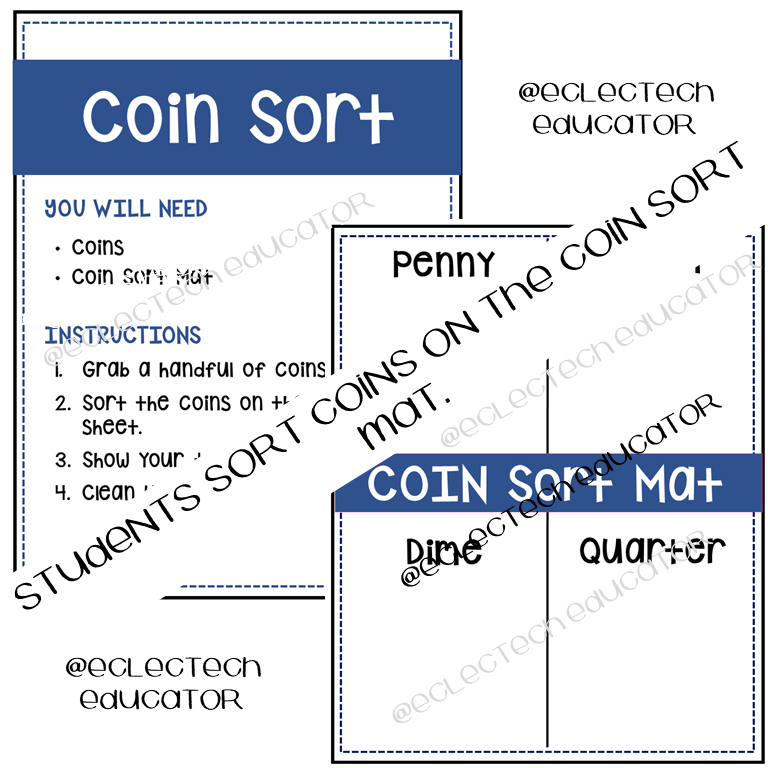
#1 Attributes - First, have students examine the coins. Actual coins or coin manipulatives help students determine each coin's attributes, name, and monetary value. Give students sorting mats for each coin and coin manipulatives to sort onto the mats. 


Conduct a quick assessment  or exit pass to ensure understanding of coin identification. Say things such as, "Give a quarter to your partner!" or "Grab 2 quarters!".


#2 Skip Counting with Like Coins -  Before being able to count assorted coins, have students learn to skip count through a series of one coin. Use coin manipulatives to have students practice counting pennies, nickels, dimes, and quarters by 1s, 5s, 10s, and 25s.  Provide a handful of pennies and have them count as a group 1, 2, 3, 4.. etc. as they push each coin out of their pile. Repeat with nickels and count 5, 10, 15, 20, etc.  -pushing a nickel out of their pile into its own pile as they say each number. Repeat with dimes and counting by 10. Finally, repeat with quarters. This can be difficult for some students, so you may not want to provide more than 4 quarters at first. Learning about quarters is important as it provides meaningful connections to fourths in fractions and quarter to and quarter after in time.


#3 Adding With Like Coins - Have students combine coins to be equivalent to another coin. For example: 
  • 5 pennies = nickel
  • 2 nickels = dime 
  • 2 dimes and 1 nickel = quarter 
  • 4 quarters = dollar
In Money Roll, money dice is combined with number dice for a fun game. Students roll the dice. They take the rolled amount on the number die of the coin rolled on the money die. They count the money. Coin manipulatives and stamps can be used to help students total the amount.


#4 Adding Money - Have students practice adding with money. I recommend A LOT of practice with adding like coins (only adding pennies) before having students add mixed coins. There are many games to help students practice adding mixed coins. 

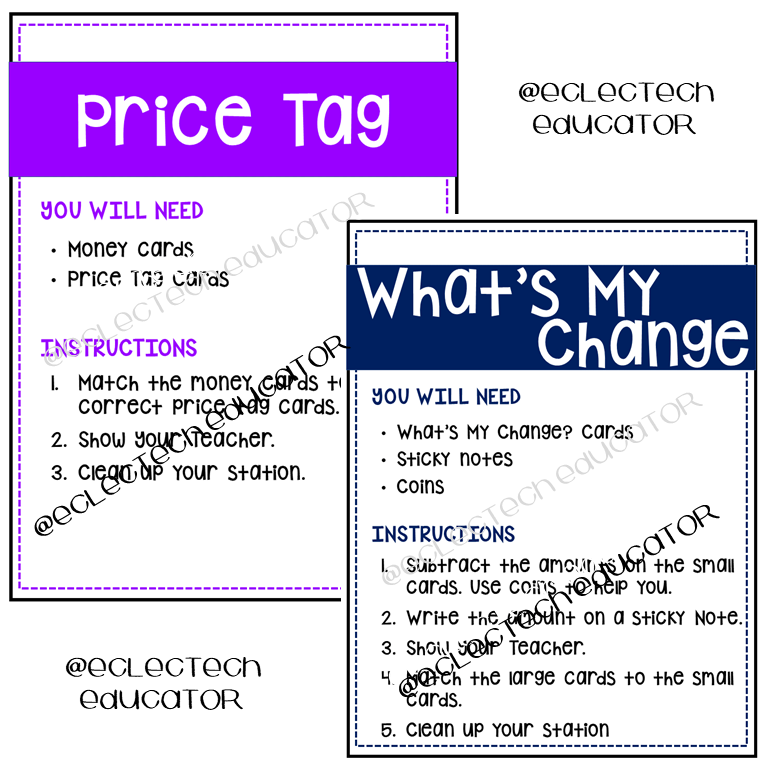
Money Jars is a fun game to help practice adding money. Distribute coins and Money Jars. Have students fill each jar with the amount of money listed on the lid. Challenge students to use the least amount of coins for each amount.


#5 Making Change - Practice making change. Establish a store and have students purchase items with coin and bill manipulatives.


I hope that this post helps provide fun and engaging ways to teach money! If you want these activities, EVERYTHING you saw in this post PLUS more - grab my Money Unit!



Friday, 22 February 2019

Task Cards

A task card is a small card (usually about a quarter size of a page) that has an activity or question on it. There is usually an accompanying task card response sheet for students to record their answers.

Many teachers are choosing task cards for worksheets. One of the main reasons is because of the versatility of the cards.

Reasons

The following reasons outline my reasons for using task cards:
  1. Multi-Purpose:  The task cards can be used in centers or stations, as part of the daily routine, as a Scoot, or as an assessment.
  2. Variety of Groupings: The task cards can be completed as independent work or in small or whole groups,
  3. Differentiated: Each student can complete a card that suits her own unique learning needs.  The task cards provide one question, as opposed to an overwhelming worksheet. Struggling students feel the same sense of accomplishment working through these task cards, rather than a visual reminder of worksheet questions they have yet to complete.  
  4. Time Saver: Task cards can be used time and time again. Laminate the cards for reuse. Preparation is reduced to the photocopying of the response sheet, or have students write their answers in their notebooks or on a separate piece of paper.
Once you give task cards a try, you will be hooked! Not only are they versatile and easy to use, the students love them.

View my mathematics task cards available in my store:


Sunday, 22 April 2018

Math Rotation and Stations

I recently posted a picture of my math rotation and the stations, which are organized and ready to use. I received many questions and requests for examples, so I am happy to share! Specifically, this post is will focus on how I organize my mathematics block and what my third grade students do during each rotation.

I have four math "stations" in my mathematics block. The four stations spell the acronym MATH.

The groups are fluid and always changing based on the skill we are working on. An exit ticket, journal entry, or group discussion is completed as the culmination of the mathematics block to consolidate thinking. The reflections are used plan subsequent minds-on (mini-lessons) and set individual goal (which are visited during conferences). Due to the fluidity of the groups, a simple way was needed to display the grouping of the students. I purchased these magnetic labels from Amazon as a solution. As the labels feature each student's name with dry erase marker, the labels are easily moved to reflect the rotation where students are currently working.


The rotations occur during the Independent Time portion of my block.


We start the block with a Minds-On focus. During this time, we activate prior knowledge, connect previous and new learnings, revisit concepts, or introduce new learnings.

The next section of the block focuses on Purposeful Practice. This is time students explore and experience concepts through the mathematical rotations. After the independent practice, the students meet in a variety of group settings to discuss and share their learning. Conferencing occurs during this time as well.

The block culminates with a reflection of the learning. Students share their learning, revisit the teaching point to reground their learning, and consolidate their thoughts.


I hope this helps with your instructional planning and answers some of your questions. If you have further questions, do not hesitate to comment.


Saturday, 12 August 2017

Classroom Organization

I have moved to a new school this year, so I decided to reorganize all of my materials and rethink how I organize my classroom. Whew! It is an exhausting process and I hope I can finish before school starts in two weeks.

Below is a sneak peek of an in-progress look at my classroom.


My manipulatives are organized into decorative boxes in the bookshelf. The boxes are organized by the big conceptual ideas in grade three: place value, addition and subtraction, fractions, geometry, measurement, multiplication and division, and statistics and probability. Baskets and two decorative boxes contain manipulates I use throughout the year, such as linking cubes, playing cards, dice, etc.

The bulletin board will display anchor charts and word wall cards. I created the header in PowerPoint.

The baskets on the shelf are for our M.A.T.H. rotation. For more information about the M.A.T.H. rotation, please see Laura Santos' blog post.

The table will display manipulatives and needed materials to complete tasks in the M.A.T.H. rotation or to provide extra practice if needed.

Visit my blog regularly for updates on my classroom organization!

Tuesday, 29 September 2015

Statistics and Probability


During the last two weeks, the students have been studying statistics and probability. We  collected, organized, and represented first-hand data using tally marks, charts, lists, bar graphs, and line plots (abstract pictographs). We surveyed other classes, played games of chance, and represented the results. To culminate our study, the students brought in a box of multi-coloured candy. We graphed the colours, determined the probability of choosing a colour, created designs with lines of symmetry, and then ate our results!