Sunday, 14 March 2021

Trickster Tales

Have you ever read trickster tales?

Trickster tales are entertaining stories that have been retold for generations as a way to teach lessons about human behaviour.  Tricksters are loveable, but cunning as they use their knowledge to play tricks on others!

Why Teach Trickster Tales?

The tales are great ways to strengthen these concepts:
  1.  Characterization
  2.  Personification
  3.  Lesson or moral
  4. Compare and contrast similar tales


Tales To Share

Almost every culture has its own trickster characters. Here are my favourites:

ANANSI is a trickster from West African and Caribbean stories, and is full of wit and cunning. Anansi and The Moss Covered Rock and Anansi and The Talking Melon are fun read alouds.

RAVEN is a trickster from the First Peoples of the Northwest Pacific Coast from Alaska to British Columbia. Raven is alternatively a clever and foolish  bird-human whose voracious hunger and greed give rise to humourous adventures. Raven: A Trickster Tale from the Pacific Northwest is a great book to share.

COYOTE is a comic trickster character from North American Indigenous stories, who is lack of wisdom gets him into trouble, and his cleverness gets him back out. Students will enjoy Coyote: A Trickster Tale from the American Southwest.

LEPRECHAUN plays several roles in Irish folklore; he is principally a roguish trickster figure who cannot be trusted and will deceive whenever possible. Clever Tom and The Leprechaun is a delightful tale.

WESAKECHAK is a trickster character whose adventures are often humourous, but unlike Plains First People tricksters he is portrayed as a staunch friend of humankind. Wesakechak Tales will be devoured by your students.


Thursday, 18 February 2021

Structures and Materials

A tennis shoe is a structure. It holds our foot securely, so we can walk or run. A bicycle is a structure. It has a certain shape and size. It is built securely so we can sit on it and it can take us places. Learning about structures can be LOADs of fun!!!


Students will look at structures in our NATURAL environment, as well as MAN MADE structures. 
The Leaning Tower of Pisa is one of the most famous structures in Italy. 
Learn about why it leans, as well as famous landmarks:


Through interactive Google Slides, students will experiment and learn about:
  • The STRENGTH of a structure is its ability to hold a load.
  • The STABILITY of a structure is its ability to maintain balance and to stay in one spot. 
  • The PROPERTIES of materials, such as STRENGTH, FLEXIBILITY, and DURABILITY, need to be considered when building materials. 
  • The TYPES of structures, such as FRAME, SOLID, and SHELL.
  • FORCES that affect the shape, balance, or position of structures.
  • STRUTS and TIES which help strengthen and stabilize structures.


If you are looking for fun ways to teach Structures and Materials, whether face-to-face or digital, this resource is for you.


Sunday, 7 February 2021

Mapping Skills

This year is certainly different! I have been teaching grade three online since September! I have been busy creating digital resources for my students!


Our current social students unit is looking at different representations of Earth. Even though many of us view maps on phone apps, students still need good map skills. Fortunately, the concepts are applicable for apply for virtual and paper maps.


1. Share map books.

    Epic has many great books that I have shared.


2. Map out fairy tales.

Read a familiar fairy tale. Design a simple map of the main character’s travels. This is a cute way to help young minds explore map skills. 


3. Map your bedroom or yard.

Turn students into junior cartographers! Students draw a room in their house or their background from a variety of perspectives, such as an aerial view and a map view. 


4. Play Battleship

The online Battleship game helps students learn grid coordinates.


5. Go on a satellite scavenger hunt.


Google Maps and Google Earth provide many opportunities for a scavenger hunt. Familiarize students with satellite images, so they can find their own house and world landmarks.  Look at satellite and street views!


If you are interested in learning more, please visit my resource, Mapping Skills. Perfect for distance learning, this social studies resource includes Google Slides™ to teach students about various representations of Earth. This interactive resource helps students understand different representations of Earth, such as maps, globes, aerial photos, and satellite images, as well as geographical concepts that help define and identify places on the earth. 


Wednesday, 30 December 2020

Data and Graphs

New math resource! Perfect for distance learning or the face-to-face classroom, this math resource is an interactive presentation to help students understand data by collecting, describing, and representing statistical information. Students learn about different types of graphs and charts and how to represent the data. The Google Slides™ or PDF activities are suited for grade two, grade three, or grade four students. 

Distance Learning - Data and Graphs includes PDF and Google Slides. 

PDF Users: The presentation and activities can be presented as a PDF. Annotated notes are provided. 

GOOGLE Users: You can download the presentation and activities directly to your Google account with just the click of a button! Print: The slides can be printed as anchor charts or used as a presentation. 

The SLIDES explain: 
  • Pictographs
  • Bar Graphs
  • Line Plots
  • Line Graphs
  • Tally Marks
  • Pie Charts
  • Charts
  • Lists

EACH type of graph is presented in three ways: Example of the graph A questions for students to collect data and then represent in a graph. A completed graph for students to interpret data.


View the preview video to learn more! 


Sunday, 23 August 2020

Mapping out the Year for Combined Grades

Teaching a split grade or combined grades? Unsure where to start? 

This video shows how to create a yearly plan! From looking at outcomes to mapping out a pacing guide, I outline how start planning.

Want a sample pacing guide and blank template as shown in the video? Join Eclectech Educator's Mailing List! After subscribing, the resources will be sent to you via email. The form can be found on the right column of the blog!

Enjoy the video! Please follow my video channel to receive more free printables and updates of new products and teaching goodies!


Thursday, 30 July 2020

How To Teach A Science Mini Lesson

I did it!
I finally made my first educational video.


I wanted to share ideas for teaching science. Using examples from my Teachers Pay Teachers resources, I share how to engage students in scientific concepts using:

  1. Connections
  2. Teaching
  3. Active Engagement
  4. Linking

The video shows how science can be hands-on, inquiry-based, and FUN!

Please enjoy the video and post your feedback.


Saturday, 11 July 2020

Science

Science is one of my favourite subjects! The students love to be engaged in activities that deepen their curiosity about the natural and constructed world.

When creating my science units, I aim to engage student in inquiry about a topic. The unit has ample opportunities to:
  • ask questions about objects, organisms, and events in the environment 
  • plan and conduct a simple investigation
  • use simple equipment and tools to gather data 
  • use data to construct a reasonable explanation 
  • communicate investigations and explanations
  • promote enjoyment of science

My science units often have a presentation to focus the inquiry and introduce each concept. It is often a discussion starter, so I display the relevant slide at the beginning of the lesson.


In my Motion and Position unit, the concept of friction is introduced. We had discussed the definition of friction as the contact force between two objects moving against each other. Now we needed to explore this concept with concrete examples. Sometimes friction is needed to slow us down. We talked about how running shoes help us on the gym floor during a lively game of tag and how winter boots help us when we step onto a patch of ice. The slide serves as starting point for our discussion and inquiry of friction. We then progressed to explore friction through hands-on investigations.


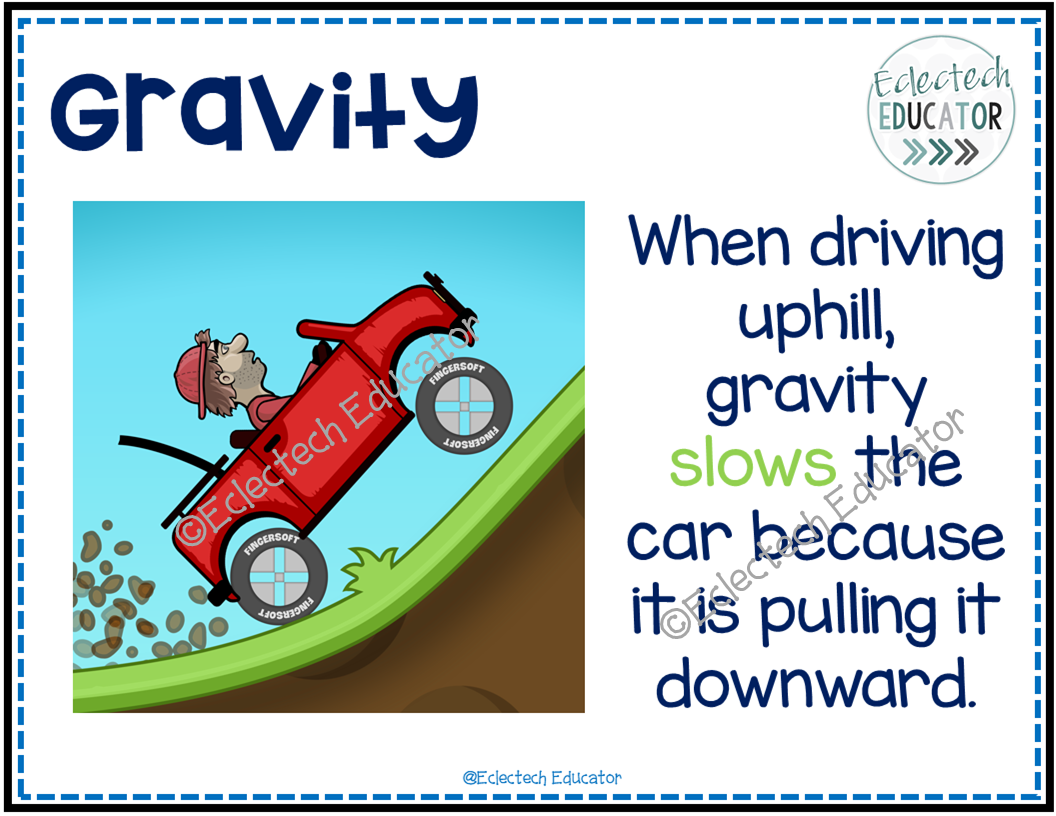
In subsequent lessons, we explored other forces that impact motion. As we explored gravity, we discussed how we need to pedal our bicycle harder on an incline. We then tested this theory of gravity using created slopes and toy cars.

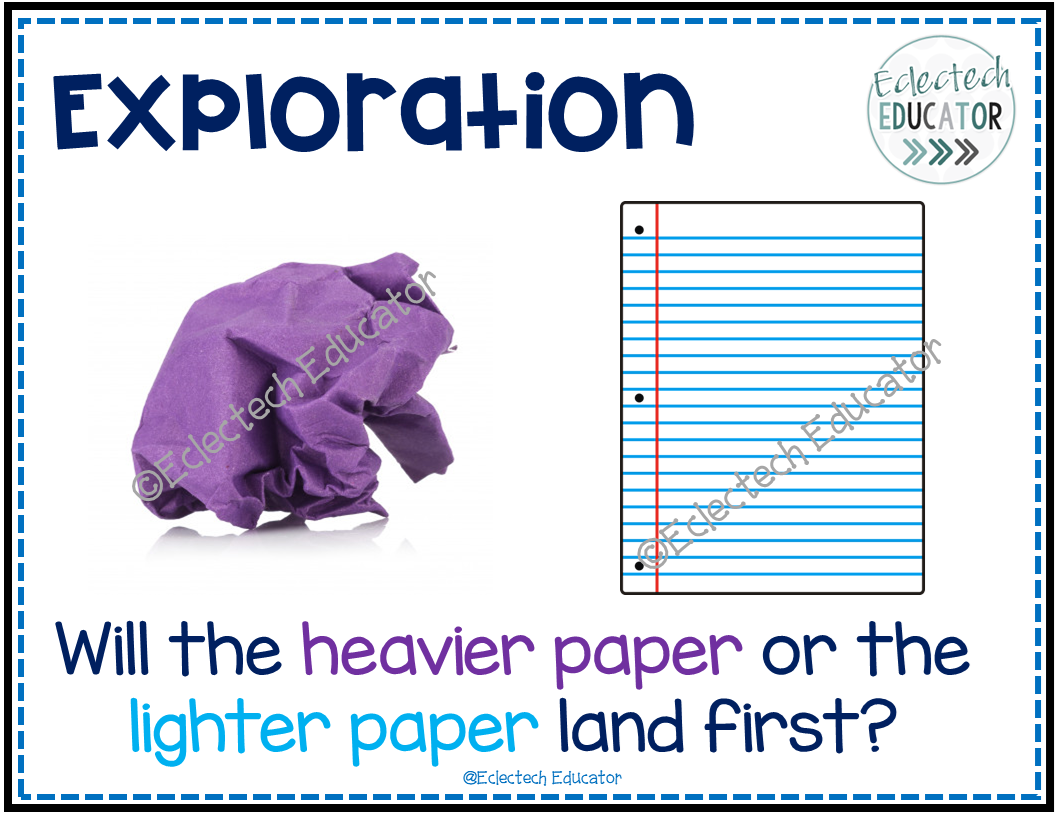
Explorations help solidify students' understanding of a concept and clear up confusions. Hands-on experiments allow students to test predictions, gather relevant data, and communicate their scientific learnings. In this exploration, we are exploring air resistance or drag.


Students are often surprised that the lighter piece lands first. This is a great opportunity to discuss drag. Resistance and friction cause changes in acceleration. Air resistance (drag) slowed down the heavier piece. Drag opposes the direction that the object is moving and slows it down.

To culminate the unit, we like to complete a hands-on project to show off our learnings. In this unit, the students build a roller coaster that can move a marble at least 2 different ways. They are provided materials and design with the following questions in mind:
  • What factors affect the movement? 
  • Is there a pattern to the movement?


We also like to play a cooperative digital game! The unit contains questions for students to answer. The next slide shows the answer. It is a fun way to check what we have learned!


This unit, Motion and Position, is available in my TPT store. It includes slides, activities, and low-prep experiments featured in this post AND MUCH MORE to help students explore motion - how things move, their relative position, and forces that impact movement.  It is perfect for distance learning and can be easily uploaded to your digital classroom.

I hope this post shows how I teach science and helps you with ideas for your classroom. As mentioned at the beginning of this post, I love teaching science!