Sunday, 28 July 2019

Math Centers

Hello!

I recently posted a picture on Instagram (@eclectecheducator) of my place value math centers. I received questions about my math center organization and rotations. I am happy to share!

Centers are part of my math rotation. I have ten centers for students to choose from at one time. The different centers can be completed in any order that the students would like. 

The independent center is a time where students are practicing skills that have already been taught during whole group and practiced in small group. The center activities include task cards, interactive activities, and constructed response math journal prompts. I laminate the directions and title page on card stock.


I put each center in a dry erase pocket. The dry erase pocket is wider and taller than a letter sized piece of paper, so the title page, direction page, recording sheets, and manipulatives fit easily. The pockets are clear, so students can quickly see which station they are choosing. The pockets are also sturdy and cheap! I purchase the pockets from my local Dollar Store, but the pockets are also available on Amazon.


I insert a station number card in each pocket to help students recall which stations they have completed.  The station cards are approximately a third of the page, so students can still see the title page behind the card.


I hope this helps!
Please post any comments or questions.



Thursday, 4 July 2019

Organizing The Classroom BEFORE The First Day

Prepping the classroom can be overwhelming. Managing classroom materials, students, lesson plans, and organizing the environment… where to start?! 

Fear not, you are definitely not alone in this quandary. Teachers have more paperwork, activities, files, writing implements, paper, books, plans, books, stickers, and arts accessories than can possibly be fit into one classroom. 

While there are many ideas on how to organize, the act of organizing is a very personal endeavour. There is not a “one size fits all” implementation plan for managing classroom materials, students, or lesson plans, and much of it is trial and error.

However, some resources for helping teachers through the organization process can help prepare and define their classroom, while allowing for personalization of the environment.

I have designed three resources to help get your classroom ready:
  1. Preparing the Classroom Before The First Day 
  2. Classroom Planning and Management
  3. Subject Organization

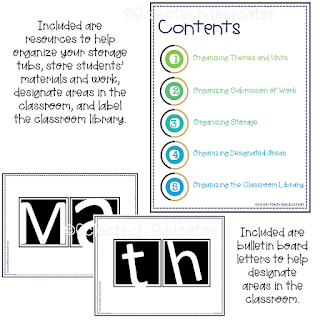
The first resource, Preparing The Classroom, focuses on organizing the environment before the students arrive for the first day of school. The included materials and suggestions help your students know where items belong and to identify designated areas in your classroom. Included in the resource are: 
  1. Organizing Your Themes and Units
  2. Organizing Students' Submission of Work 
  3. Organizing Storage of Students' Notebooks and Duotangs
  4. Labelling Designated Areas In the Classroom
  5. Organizing the Classroom Library 


Sunday, 19 May 2019

Canadian Government


This week, we have been focusing on the three levels of the Canadian government. Canada's three main levels of government are: 
  1. The federal level 
  2.  The provincial level 
  3.  The municipal level 
Across the country, there are also band councils, which govern First Nations communities. These elected councils make decisions that affect their local communities. 

Each level of government has a different structure and responsibilities.

To help students understand the government structure, I created word cards which students organized to represent the hierarchical structure. I created cards for each level of government. A completed chart was also created for use as an anchor chart, an answer key for teacher use or student checking, or for student reference.

The cards can also be used to help students acquire vocabulary related to government structure.

The Canadian Government cards are available in my TPT store.


To compliment the Canadian Government Word Cards, I created a presentation. The 84 page/slides resource details the Canadian government. It describes:
  • The structure of each level of government - federal, provincial/territorial, and municipal 
  • The responsibilities of each of the three levels of government 
  • How a bill becomes a law Canadian symbols 
The Canadian Government Anchor Charts and Presentation  is available in my TPT store.


Sunday, 5 May 2019

Year End Math Review

Why Review Math Concepts?

In addition to promoting retention, review should be incorporated into mathematics instruction for many reasons:
  1. Review promotes continuity and helps students to attain a more comprehensive view of the mathematical topics covered. It helps them summarize main ideas, develop generalizations, and get an overall view of what they have been learning.
  2. Review helps students to consolidate what they have learned, enabling them to fit ideas into new patterns.
  3. Review serves as a diagnostic tool, revealing strengths and areas of concern to students and teachers. It helps teachers identify what is already known and what is not yet known; then reteaching can be planned.
  4. Review assures that the prerequisites needed for learning new content have been mastered.
  5. Review adds to students' confidence in their ability to move successfully to new mathematical topics.

Review does not have to be drill and kill! 

Games can provide effective review. In a motivating situation, students can focus on the mathematics and enjoy the process of recalling and restructuring.

Grade Three Math Review
I created a Year End Review which features 15 games with accompanying review worksheets and quick assessments to review math outcomes. The package covers outcomes/standards for: 

  • place value
  • addition
  • subtraction 
  • multiplication
  • division 
  • rounding
  • linear measurement
  • time
  • perimeter and area
  • patterns 
  • statistics
  • planar geometry
  • spatial geometry
  • fractions
  • money 


Grade Three Math Review
The package includes: 
  1. 15 cooperative activities for students to collaboratively review math concepts. The activities are simple to make and include all the needed materials. 
  2. 15 review pages. Each review page has a coordinating answer key. 
  3. 15 checklists. There is a checklist for each review page. The checklist coordinates with each question to quickly identify the intended outcome or standard.


The package is designed to be used in the following way, but can it be easily modified to meet your instructional needs:
  1. With a partner, students choose one of the 15 math concepts to work on. 
  2. With a partner, students review the chosen math concept by playing a math game.
  3. Independently, students complete the coordinating math concept review page. 
  4. Assess students’ ability using the included checklist. The checklist follows each review page and lists the intended outcome check for each question. 
  5. An answer key and a math concept checklist are included.


I hope this resource helps you end your year on a relaxing note!

Grade Three Math Review

Grade Three Math Review


Thursday, 25 April 2019

Teaching About Money

Teaching about money is a great way to end the year as the concepts lend itself to active investigations, playing money games, and counting coins and making change.


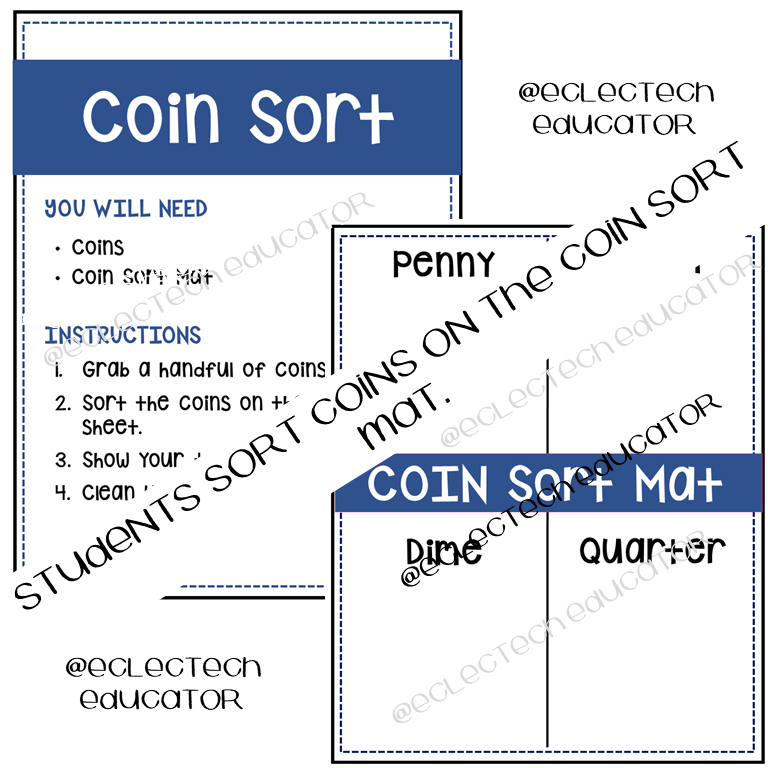
#1 Attributes - First, have students examine the coins. Actual coins or coin manipulatives help students determine each coin's attributes, name, and monetary value. Give students sorting mats for each coin and coin manipulatives to sort onto the mats. 


Conduct a quick assessment  or exit pass to ensure understanding of coin identification. Say things such as, "Give a quarter to your partner!" or "Grab 2 quarters!".


#2 Skip Counting with Like Coins -  Before being able to count assorted coins, have students learn to skip count through a series of one coin. Use coin manipulatives to have students practice counting pennies, nickels, dimes, and quarters by 1s, 5s, 10s, and 25s.  Provide a handful of pennies and have them count as a group 1, 2, 3, 4.. etc. as they push each coin out of their pile. Repeat with nickels and count 5, 10, 15, 20, etc.  -pushing a nickel out of their pile into its own pile as they say each number. Repeat with dimes and counting by 10. Finally, repeat with quarters. This can be difficult for some students, so you may not want to provide more than 4 quarters at first. Learning about quarters is important as it provides meaningful connections to fourths in fractions and quarter to and quarter after in time.


#3 Adding With Like Coins - Have students combine coins to be equivalent to another coin. For example: 
  • 5 pennies = nickel
  • 2 nickels = dime 
  • 2 dimes and 1 nickel = quarter 
  • 4 quarters = dollar
In Money Roll, money dice is combined with number dice for a fun game. Students roll the dice. They take the rolled amount on the number die of the coin rolled on the money die. They count the money. Coin manipulatives and stamps can be used to help students total the amount.


#4 Adding Money - Have students practice adding with money. I recommend A LOT of practice with adding like coins (only adding pennies) before having students add mixed coins. There are many games to help students practice adding mixed coins. 

Money Jars is a fun game to help practice adding money. Distribute coins and Money Jars. Have students fill each jar with the amount of money listed on the lid. Challenge students to use the least amount of coins for each amount.


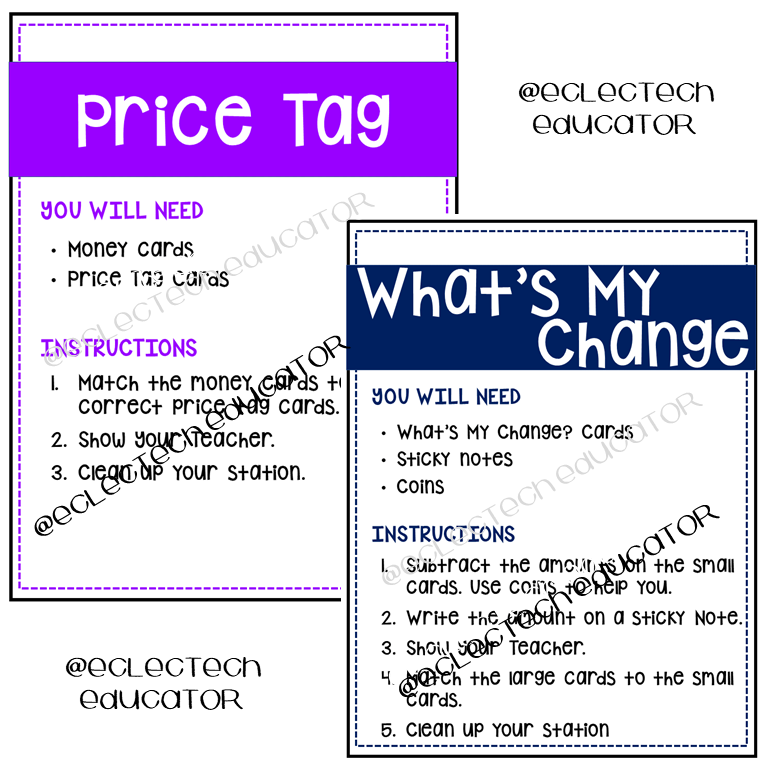
#5 Making Change - Practice making change. Establish a store and have students purchase items with coin and bill manipulatives.


I hope that this post helps provide fun and engaging ways to teach money! If you want these activities, EVERYTHING you saw in this post PLUS more - grab my Money Unit!


Saturday, 13 April 2019

Easter Scavenger Hunt for Staff

Celebrate Easter in the workplace with a simple, yet fun-filled office scavenger hunt.

This scavenger hunt is aimed to help the staff get to know each other, their achievements, and to have fun.  The staff members work in pairs to complete four tasks.

  1. The first task to find plastic eggs filled with treats! 
  2. The second and third tasks are questions about the staff, The questions range from "What is the height of the tallest staff member?" and "What staff members play competitive sports?".
  3. The final task is the completion of a "bunny" phrased activity. The task can be videotaped to show at staff meetings. An example is "Demonstrate the bunny hop".
Completion of the tasks are awarded with a chocolate bunny!


Respond if you would like a copy of the scavenger hunt!


Saturday, 23 March 2019

Planar Figures - Activities and Games


My resource, Planar Figures - Activities and Games, had had a face lift. New games, better design, and a fresh new look.

This packet contains 78 pages of materials to use when teaching students about 2-dimensional geometry or planar geometry. The resource helps students identify, describe, sort, and construct planar figures.

Terms such as congruent, quadrilateral, right angle, polygon, interacting lines, and parallelograms are explored. The games require minimal prep and are easy to play. The games can be part of a whole class instruction, pair work, or placed in stations. 

This resource includes the following: 
  • Planar Geometry Word Wall Vocabulary Cards 
  • Planar Geometry Checklist 
and 9 GAMES AND ACTIVITIES
  •  Guess The Figure 
  • Planar Figure Booklet 
  • Attribute Look 
  • Match It! 
  • Planar Poster
  • Sort It Out! 
  • Who Am I? 
  • Build It! 

Enjoy the resource! 
Please visit my store, Eclectech Educator, for more mathematics resources.