Thursday, 25 April 2019

Teaching About Money

Teaching about money is a great way to end the year as the concepts lend itself to active investigations, playing money games, and counting coins and making change.


#1 Attributes - First, have students examine the coins. Actual coins or coin manipulatives help students determine each coin's attributes, name, and monetary value. Give students sorting mats for each coin and coin manipulatives to sort onto the mats. 
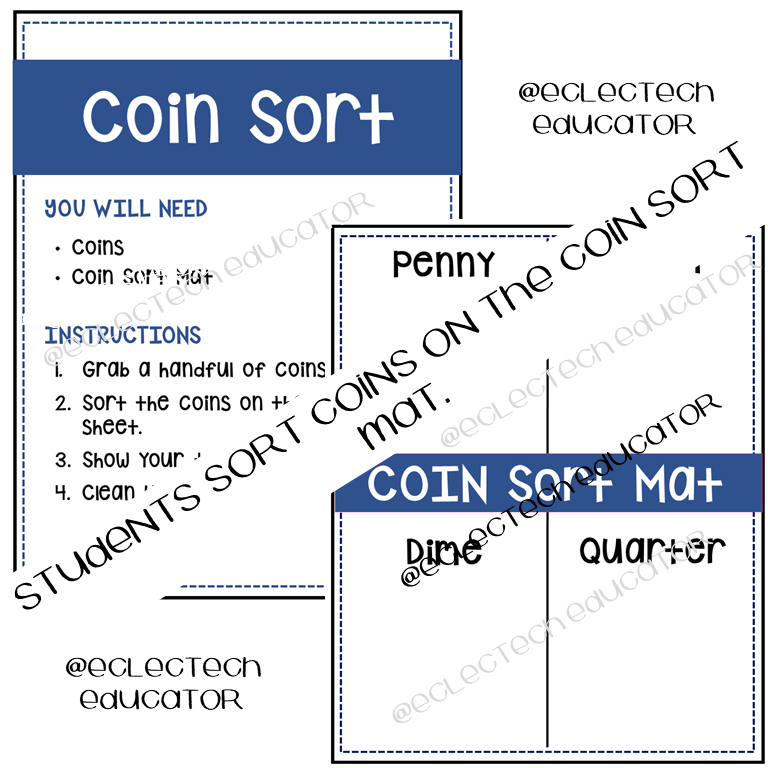


Conduct a quick assessment  or exit pass to ensure understanding of coin identification. Say things such as, "Give a quarter to your partner!" or "Grab 2 quarters!".


#2 Skip Counting with Like Coins -  Before being able to count assorted coins, have students learn to skip count through a series of one coin. Use coin manipulatives to have students practice counting pennies, nickels, dimes, and quarters by 1s, 5s, 10s, and 25s.  Provide a handful of pennies and have them count as a group 1, 2, 3, 4.. etc. as they push each coin out of their pile. Repeat with nickels and count 5, 10, 15, 20, etc.  -pushing a nickel out of their pile into its own pile as they say each number. Repeat with dimes and counting by 10. Finally, repeat with quarters. This can be difficult for some students, so you may not want to provide more than 4 quarters at first. Learning about quarters is important as it provides meaningful connections to fourths in fractions and quarter to and quarter after in time.


#3 Adding With Like Coins - Have students combine coins to be equivalent to another coin. For example: 
  • 5 pennies = nickel
  • 2 nickels = dime 
  • 2 dimes and 1 nickel = quarter 
  • 4 quarters = dollar
In Money Roll, money dice is combined with number dice for a fun game. Students roll the dice. They take the rolled amount on the number die of the coin rolled on the money die. They count the money. Coin manipulatives and stamps can be used to help students total the amount.


#4 Adding Money - Have students practice adding with money. I recommend A LOT of practice with adding like coins (only adding pennies) before having students add mixed coins. There are many games to help students practice adding mixed coins. 

Money Jars is a fun game to help practice adding money. Distribute coins and Money Jars. Have students fill each jar with the amount of money listed on the lid. Challenge students to use the least amount of coins for each amount.


#5 Making Change - Practice making change. Establish a store and have students purchase items with coin and bill manipulatives.
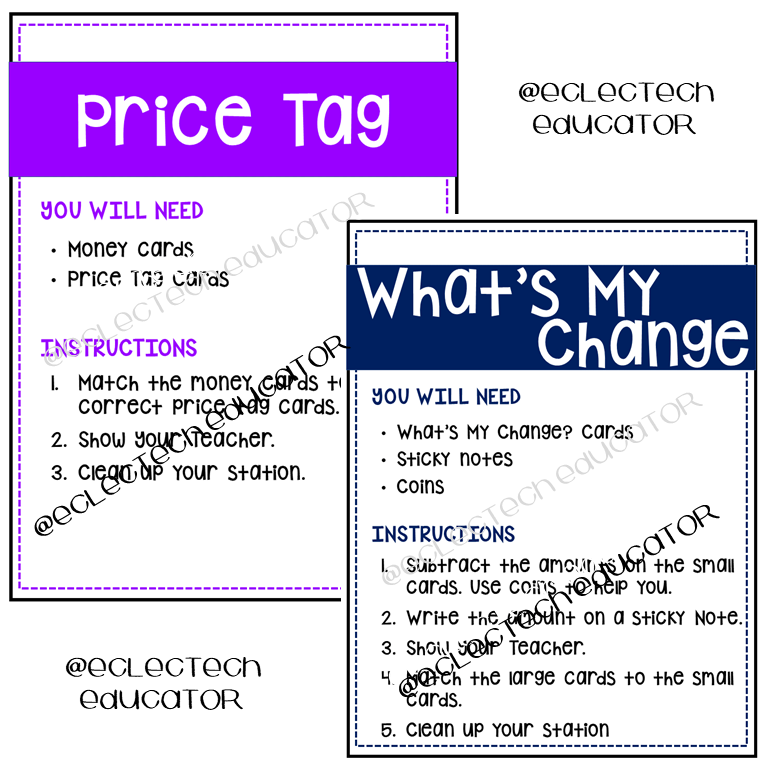


I hope that this post helps provide fun and engaging ways to teach money! If you want these activities, EVERYTHING you saw in this post PLUS more - grab my Money Unit!



Saturday, 13 April 2019

Easter Scavenger Hunt for Staff

Celebrate Easter in the workplace with a simple, yet fun-filled office scavenger hunt.

This scavenger hunt is aimed to help the staff get to know each other, their achievements, and to have fun.  The staff members work in pairs to complete four tasks.

  1. The first task to find plastic eggs filled with treats! 
  2. The second and third tasks are questions about the staff, The questions range from "What is the height of the tallest staff member?" and "What staff members play competitive sports?".
  3. The final task is the completion of a "bunny" phrased activity. The task can be videotaped to show at staff meetings. An example is "Demonstrate the bunny hop".
Completion of the tasks are awarded with a chocolate bunny!


Respond if you would like a copy of the scavenger hunt!


Saturday, 23 March 2019

Planar Figures - Activities and Games


My resource, Planar Figures - Activities and Games, had had a face lift. New games, better design, and a fresh new look.

This packet contains 78 pages of materials to use when teaching students about 2-dimensional geometry or planar geometry. The resource helps students identify, describe, sort, and construct planar figures.

Terms such as congruent, quadrilateral, right angle, polygon, interacting lines, and parallelograms are explored. The games require minimal prep and are easy to play. The games can be part of a whole class instruction, pair work, or placed in stations. 

This resource includes the following: 
  • Planar Geometry Word Wall Vocabulary Cards 
  • Planar Geometry Checklist 
and 9 GAMES AND ACTIVITIES
  •  Guess The Figure 
  • Planar Figure Booklet 
  • Attribute Look 
  • Match It! 
  • Planar Poster
  • Sort It Out! 
  • Who Am I? 
  • Build It! 

Enjoy the resource! 
Please visit my store, Eclectech Educator, for more mathematics resources.


Friday, 22 February 2019

Task Cards

A task card is a small card (usually about a quarter size of a page) that has an activity or question on it. There is usually an accompanying task card response sheet for students to record their answers.

Many teachers are choosing task cards for worksheets. One of the main reasons is because of the versatility of the cards.

Reasons

The following reasons outline my reasons for using task cards:
  1. Multi-Purpose:  The task cards can be used in centers or stations, as part of the daily routine, as a Scoot, or as an assessment.
  2. Variety of Groupings: The task cards can be completed as independent work or in small or whole groups,
  3. Differentiated: Each student can complete a card that suits her own unique learning needs.  The task cards provide one question, as opposed to an overwhelming worksheet. Struggling students feel the same sense of accomplishment working through these task cards, rather than a visual reminder of worksheet questions they have yet to complete.  
  4. Time Saver: Task cards can be used time and time again. Laminate the cards for reuse. Preparation is reduced to the photocopying of the response sheet, or have students write their answers in their notebooks or on a separate piece of paper.
Once you give task cards a try, you will be hooked! Not only are they versatile and easy to use, the students love them.

View my mathematics task cards available in my store:


Sunday, 16 December 2018

New Resource - Canada and Mapping Skills

Struggling to teach mapping skills? I hope my new resource will help.

The resource is a PowerPoint Presentation which can be used as a presentation, a review, anchor charts, or a bulletin board.

The resource has 145 slides which encompass:
  1. Various representations of the Earth
  2. The continents
  3. The oceans
  4. The hemispheres
  5. Canada
  6. Canadian provinces and territories - their locale and attractions

This resource is designed to help students master mapping skills in the following ways:
  • Use and interpret various model representations of the Earth, such as maps, globes aerial photographs, and satellite images. 
  • Identify and locate geographical concepts, such as continents, countries, borders, hemispheres, oceans, prime meridian, and the equator on a map or globe. 
  • Locate and list the provinces and territories in Canada.
  • Travel through Canada to determine landmarks which define the country’s provinces and territories.


Monday, 3 December 2018

Information Writing - New Resource!

Yahoo!
I just uploaded my new unit, Information Writing, to my TPT store.

In this unit of study, students craft informational books about topics of their choice. Their chapters will feature topic sentences, facts and supporting details, and summary sentences.

This unit of study is organized around 14 big ideas of persuasive texts. The primary goal of the unit of study is to help students become stronger writers. The development of writing skills and strategies are the emphasis.

The 14 sessions include:
  1.  Launching The Unit 
  2. Learning From Mentor Texts 
  3. Identifying Facts 
  4. Noticing Text Structure 
  5. Introducing Topics
  6.  Hooking Readers 
  7. Adding Details 
  8. Concluding Topics 
  9. Adding Text Features 
  10. Linking Paragraphs with Transition Words 
  11. Enriching Vocabulary (Using Technical Terms) 
  12. Detailing Content (Creating A Table of Contents) 
  13. Revising and Editing 
  14. Publishing and Creating 

Each big idea has been developed into a session, or a lesson plan, which consists of the following:
  1.  Anchor Chart(s)
  2.  Preparing to Write (Mini-Lesson) 
  3. Independent Writing 
  4. Partner Share 
  5. Reflection

Enjoy this 88 page resource as students delve into and navigate informational texts!


Sunday, 25 November 2018

Cyber Sale On Monday


Cyber Sale savings from TpT are coming your way.
From Monday, November 26th (12:01am ET) through Tuesday, November 27th (11:59pm ET), you can save up to 25% on all the resources on your wish list.

ALL of my products are on sale!
Just use promo code CYBER18 at checkout.
Happy shopping!