Friday, 29 December 2017

Navigating Non-Fiction In Reader's Workshop

I hope you are having a WONDERFUL winter break! To celebrate the upcoming New Year, I have uploaded my Reader's Workshop unit Navigating Non-Fiction to my store!


The unit of study has 13 sessions for your students to investigate the genre of non-fiction. Each session has a detailed lesson plan, anchor charts, and a group task.


In the first session, students ready their minds to reading non-fiction by identifying features which distinguish fiction from non-fiction.

Each session includes an anchor chart and a group investigation!


I hope you enjoy my new resource! 
Visit my store for this resource and many others!


Wednesday, 11 October 2017

Building A Reading Life

It is time to begin, to set Reader’s Workshop into motion. The work of utmost importance, the work that unites and underlines the unit of study, Building A Reading Life,  is to help students become avid and reflective readers. 

The purpose of the Building A Reading Life unit is to launch a lifelong passion for reading - to  empower readers with a sense of personal agency about their own reading. This unit of study, based on the work of Lucy Calkins, focuses on ownership for building their own reading life. This powerful message resonates throughout the unit of study as readers self-select books, set reading goals, monitor their comprehension and fluency, and actively discuss their reading with peers. As the conclusion of the three bends in Building A Reading Life, students will have begun to build a reading life by fashioning a literate identity for themselves.


Saturday, 19 August 2017

Classroom Organization


Here is a sneak peak at my unfinished classroom library. The bookshelf showcases my classroom library. The baskets are organized by genre, popular authors, favourite series, and subject areas. The basket labels change throughout as student interest dictates. The baskets are from the Dollar Store. I made my labels and the resource is available in my TPT store. The bin labels are laminated, hole punched, and attached to the basket with a cable tie. This allows quick and easy change of basket labels if needed. 
Each book is labelled with a coordinating book label. The book labels are part of my Classroom Library Label resource. The top shelf will display featured mentor texts. The black and white box holds read aloud aids - a pointer, reading fingers, sticky notes, highlighter tape, highlighters, small white board, dry erase markers, etc.
The lower bookshelf holds student duotangs and notebooks. As the students have flexible seating, their duotangs and notebooks are housed in a central location. The baskets are from Michaels and the labels are from my store

The bulletin board is a work in progress as school does not begin for two weeks. It is my Focus Board. The schedule cards are placed in the organizer on the left. The four clipped board will showcase the outcomes. The black board underneath will showcase I Can statements. On the far right, two canvas prints feature quotes to inspire students. I have yet to hang the third poster and the Focus Wall title.

Hope you enjoyed the preview!


Tuesday, 15 August 2017

Saturday, 12 August 2017

Classroom Organization

I have moved to a new school this year, so I decided to reorganize all of my materials and rethink how I organize my classroom. Whew! It is an exhausting process and I hope I can finish before school starts in two weeks.

Below is a sneak peek of an in-progress look at my classroom.


My manipulatives are organized into decorative boxes in the bookshelf. The boxes are organized by the big conceptual ideas in grade three: place value, addition and subtraction, fractions, geometry, measurement, multiplication and division, and statistics and probability. Baskets and two decorative boxes contain manipulates I use throughout the year, such as linking cubes, playing cards, dice, etc.

The bulletin board will display anchor charts and word wall cards. I created the header in PowerPoint.

The baskets on the shelf are for our M.A.T.H. rotation. For more information about the M.A.T.H. rotation, please see Laura Santos' blog post.

The table will display manipulatives and needed materials to complete tasks in the M.A.T.H. rotation or to provide extra practice if needed.

Visit my blog regularly for updates on my classroom organization!

Monday, 24 July 2017

Rotating Banner


Playing today! Thrilled with my new rotating banner for my TPT store!

Place Value

Number sense  refers to a student’s “fluidity and flexibility with numbers,” (Gersten & Chard, 2001). The student has a sense of what numbers mean, understands their relationship to one another, is able to perform mental math, understands symbolic representations, and can use those numbers in real world situations. 

The National Council of Teachers in 1989 identified the following five components that characterize number sense: 
  •  Number meaning
  • Number relationships 
  • Number magnitude 
  • Operations involving numbers and referents for number 
  • Referents for numbers and quantities
Conceptual understanding of place value is integral to the development of numbers sense. Followers have asked about how I teach place value, as it is often the unit which kicks off a new school year. Due to requests, I have updated my Place Value resource on my TPT store. Click on the picture to obtain your free sample of my unit.


We begin by playing with big numbers and developing a sense of magnitude - students love reading and writing numbers beyond 1 000. We read their phone number as a large number and look for examples of the magnitude of numbers in our environment. Reading Schwartz' How Much is A Million culminates the investigation.

The students represent numbers in a variety of compositions - standard form, expanded form, written form, and with models. Activities for representing numbers are included in my freebie.


We continue with looking at number patterns on the hundreds chart, calendars, and on number lines. Activities for the hundreds chart and calendars are included in the free resource. This leads to an investigation of skip counting patterns. Students love to make a series of patterns - one which contains an error - and have a classmate deduce the incorrect sequence. We progress to order numbers in ascending and descending order.

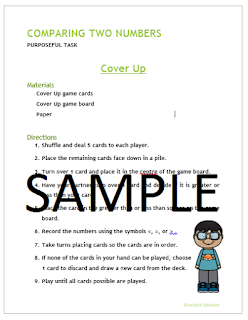
We represent the relationship between numbers symbolically using <, >, and =. Again, activities to develop these conceptual understandings are found in my freebie.


The unit finishes with a look at estimating using referents. We place numbers on a number line and round numbers to the nearest 10 and 100. Once again, activities can be found in the free resource. The image below is the game board for the rounding activity.


I hope you had a restful summer and these ideas help make the transition back to school easier!